
This is a FAQ page taken from a webinar created by Jeff Gephart of Efficiency Vermont/Vermont Energy Investment Corp.
FAQ's & INFORMATION
How do you know whether a property is energy efficient?
How do you know whether a property is energy efficient? What about what's hidden from view?
What is a Home Energy Rating?
Home Energy Rating History & Regulation
What Uses Home Energy Ratings?
What information does a Home Energy Rating provide?
What information does a Home Energy Rating certificate provide?
Home Energy Ratings - During Home Design
Old vs. New Home Energy Ratings
Converting Old Home Energy Ratings to New
When are Home Energy Ratings Most Likely to be Found?
ENERGY STAR® Home Program Sponsors
RESNET Accredited Rating Agencies
How do you know whether a property is energy efficient?
You can search for energy features of a home in the MLS that are indicators:
high efficiency heating systems
energy-efficient appliances
solar panels
How do you know whether a property is energy efficient? What about what's hidden from view?
Better or more insulation or quality air sealing
Just knowing what components are included in a home is different from knowing the home's bottom line energy-efficient or lack thereof.
When it comes to measuring a home's energy efficiency, look for a Home Energy Rating whenever possible.
What is a Home Energy Rating?
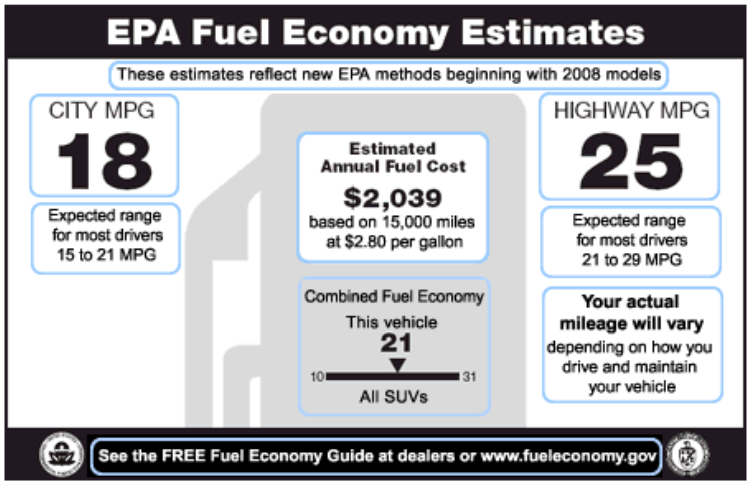
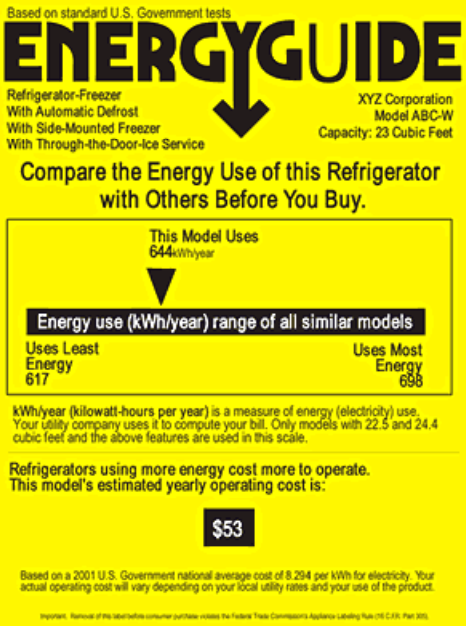
A Home Energy Rating is similar to the mileage rating on a new car. | It's also similar to the EnergyGuide label, which is used to identify the energy efficiency of appliances, water heaters, air conditioners, and heating equipment. |
 |  |
A Home Energy Rating provides a nationally recognized standard for measuring a home's energy-efficiency and projecting its energy use. In most instances, Home Energy Ratings are performed on newly constructed homes (most commonly when a home is seeking certification in an energy-efficiency or green building certification program).
Home Energy Ratings may also be used with existing homes (most commonly occurs when an existing home is involved in an energy-efficiency upgrade program or is seeking an EEM energy-efficient mortgage).
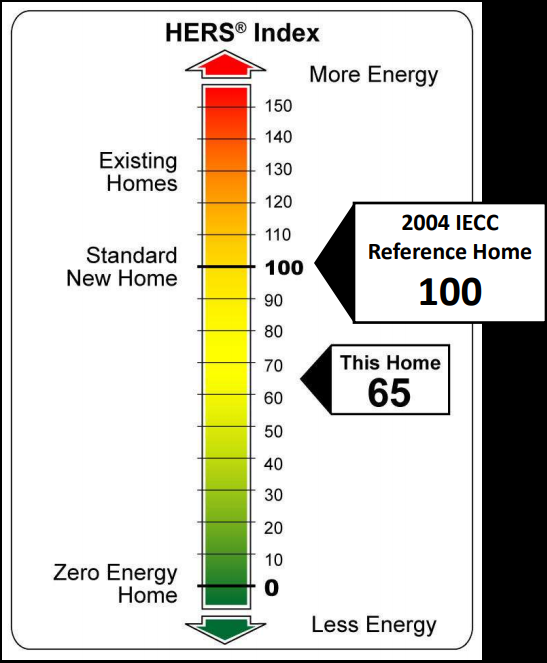
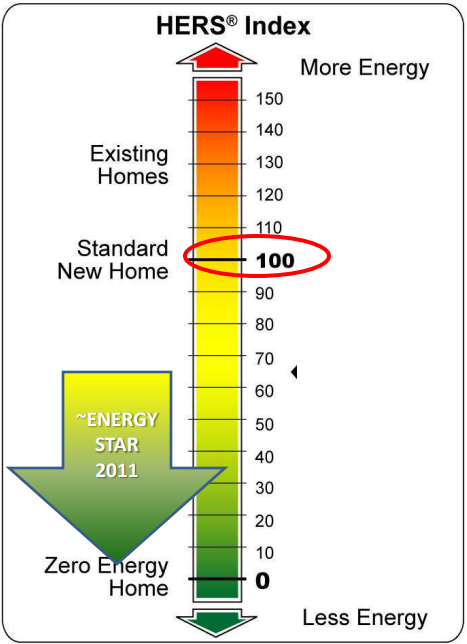
It compares the rated home to itself built to the prescriptive specifications of the 2004 International Energy Conservation Code (IECC) Reference Home. | While scores for energy code compliance or ENERGY STAR® Homes change over time, the Reference Home stays at 100 points. The HERS Index scale goes from 0 to 500 points and can model an existing home up to 400% less efficient than the 100 point Reference Home. |
 |  |
Home Energy Rating History & Regulation
In 1995, the National Association of State Energy Officials and Energy Rated Homes of America founded the Residential Energy Services Network (RESNET) to develop a national market for Home Energy Rating Systems and for energy-efficient mortgages (EEMs).
Home Energy Ratings and Rating Agencies must meet quality standards promulgated and maintained by RESNET.
Home Energy Raters must also be accredited through RESNET and their work audited by their agency. They also must be re-certified periodically through RESNET.
What Uses Home Energy Ratings?
Building and real estate professionals to market energy-efficient homes.
Mortgage industry for capitalizing energy efficiency in mortgages (EEMs)
Financial industry for certification of "white tags"
Federal government for verification of building energy performance for:
Federal tax credit qualification (builder tax credit)
EPA ENERGY STAR® labeled homes
United States Department of Energy Building America program
States or municipalities for certification of minimum energy code compliance (16 states, including VT)
Green building certification programs like LEED for Homes and the National Green Building Standard
What information does a Home Energy Rating provide?
A Home Energy Rating certificate provides important information about the energy-efficiency of the Rated home.
Information is provided via issuance of a Home Energy Rating Certificate.
Home Energy Ratings can be calculated based on plans for a home, a "Proposed from Plans" rating.
Proposed from Plants Home Energy Ratings are re-calculated based on final construction details and performance testing after the home is complete.
What information does a Home Energy Rating certificate provide?
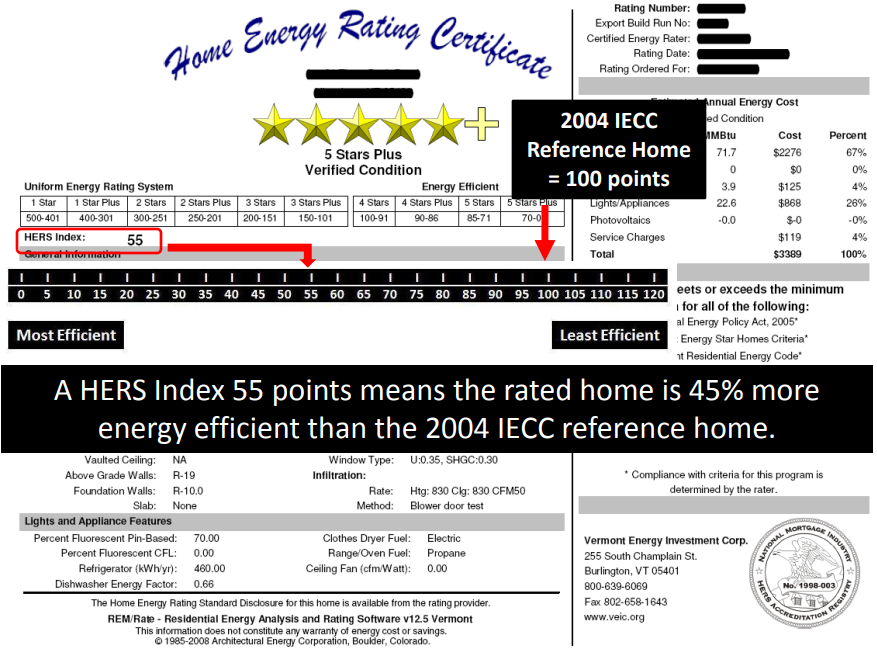 A Home Energy Rating certificate provides important information about the energy-efficiency of the Rated home. First and foremost it provides the Home Energy Rating Index Score. The Index score is the bottom-line energy-efficiency achieved by the home based on the home's construction characteristics and its performance when tested at completion.
Home Energy Ratings - During Home Design
When a "proposed from plans" Home Energy Rating is performed, a Home Energy Rater can evaluate what impact energy-efficiency upgrades would make and report on improvements to the Index score, savings in energy use, and savings in cost between the initial plan and the home with the energy-efficiency upgrades included.
Other important calculations and reports are usually available that can help a building designer improve the home design since the software used to calculate the Home Energy Rating can display energy use attributed to specific components of the home.
Old vs. New Home Energy Ratings
The RESNET Home Energy Rating Index scale was phased into use nationwide and in Vermont beginning July 1, 2006. Before then, an older "classic" Home Energy Rating scale was used.
With the Classic ratings, the higher the score the more energy-efficient the home. There is also a Star system overlay that aligned nicely with compliance thresholds for ENERGY STAR® Homes and state energy codes in some jurisdictions.
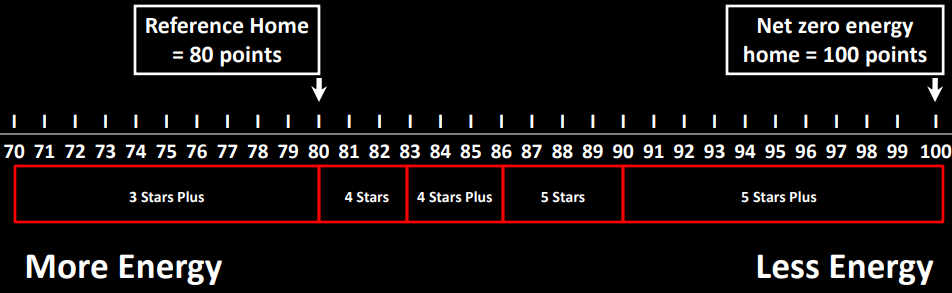
Classic ratings may display decimal fractions of points (e.g 86.9) though a whole point value Classic Rating score would display without a decimal point (e.g 86).
Converting Old Home Energy Ratings to New
There is a formula that can be used to convert an older "classic" Home Energy Rating to a current Index rating.
This conversion should always be used when a home with a Classic HERS is being entered for resale.
The formula is: (100 - Classic HERSScore) x 5 = Index HERS Score (rounded with no decimal places)
When are Home Energy Ratings Most Likely to be Found?
Home Energy Ratings are used to determine United States EPA/DOE ENERGY STAR® Home compliance (for homes using the EPA's Performance Path). The market penetration of ENERGY STAR® Homes tells us approximately the market share of homes in New England with Home Energy Ratings.
What Penetration Have ENERGY STAR® Homes Achieved in the New England Market?
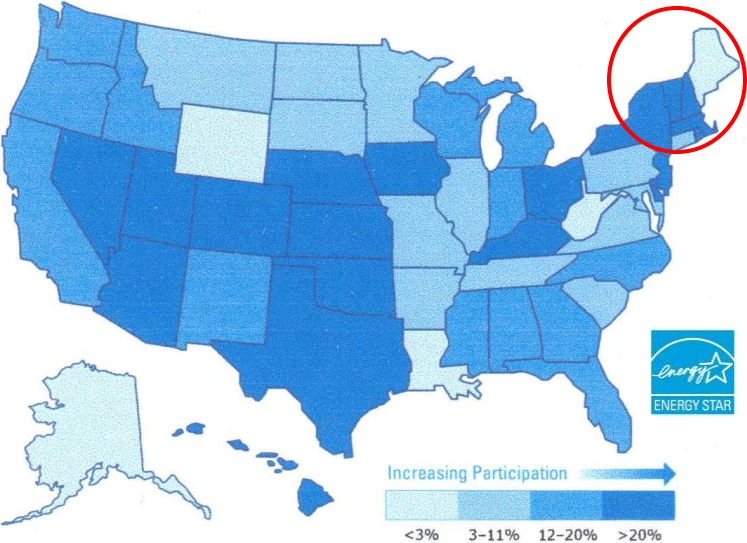 This image indicates ENERGY STAR® site-built, single-family new homes versus permits. Source: EPA

1. In addition to site-built, there are ENERGY STAR® qualified multi-family homes, as well as ENERGY STAR® qualified manufactured homes. However, these homes are not included in the indices because of differences in the definition and track of these types of homes by the U.S EPA and Census. ENERGY STAR® qualified new homes data is submitted quarterly to the EPA on behalf of builders by third-party rating provides accredited by the Residential Energy Services Network (RESNET).
2. These are final 2009 Census numbers as of 5/5/2010.
ENERGY STAR® Home Program Sponsors
Home Energy Ratings have most frequently been completed on newly constructed homes and in particular on homes in the U.S EPA/DOE ENERGY STAR® Home labeling program. The following lists ENERGY STAR® Home Program Providers:
New Hampshire
ENERGY STAR® Homes services are sponsored by the following utilities:
| National Grid | New Hampshire Electric Co-Op |
| Public Service of NH | Unitil |
Resources: NH Saves
Vermont
Previous utility programs and since 2000, Efficiency Vermont's Residential New Construction Service, offered at no charge to participants, has provided Home Energy Ratings to over 7,000 new and significantly renovated homes over the past 14 years. Home Energy Ratings can be used to document compliance with Vermont's Residential Building Energy Standards (VT energy code).
Resources: Efficiency Vermont; Efficiency Vermont's Residential New Construction Services
Maine
There is no official sponsor for a residential new construction program in Maine. Maine homes have been certified as ENERGY STAR Homes in the EPA's guidelines by accredited Raters. Other homes have had Home Energy Ratings performed for purposes of Builders' Challenge and/or verifying Federal Energy Tax Credits.
Maine Housing works with the Energy Programs Consortium and lenders to promote and support ENERGY STAR® mortgages in Maine.
Massachusetts
The Massachusetts New Homes with ENERGY STAR® program is funded by the local electric and gas utility companies and energy efficiency service providers.
Sponsors include:
| Bay State Gas | Berkshire Gas |
| Cape Light Compact | National Grid |
| NSTAR Electric/Gas | New England Gas Company |
| Western Massachusetts Electric |
Resources: Energy Star Homes; Energy Ratings in MA
RESNET Accredited Rating Agencies
New Hampshire
- Conservation Services Group: (888) 887-8841 (PSNH & National Grid)
- GDS Associates: (800) 437-4495 (PSNH, NHEC, & Unitil)
- Horizon Residential Energy Services NH: (603) 369-4833 (PSNH, NHEC, & Unitil)
Vermont
Vermont Energy Investment Corp (VEIC): (800) 639-6069
VEIC also operates Efficiency Vermont who provides Home Energy Ratings at no charge for residential new construction and gut-rehab service participants in VT. Efficiency Vermont Residential New Construction Services (800) 893-1997
Maine
- GDS Associations: (800) 437-4495
- Horizon Residential Energy Services Maine: (207) 221-3221
- Conservation Services Group: (888) 887-8841
Massachusetts